The short answer
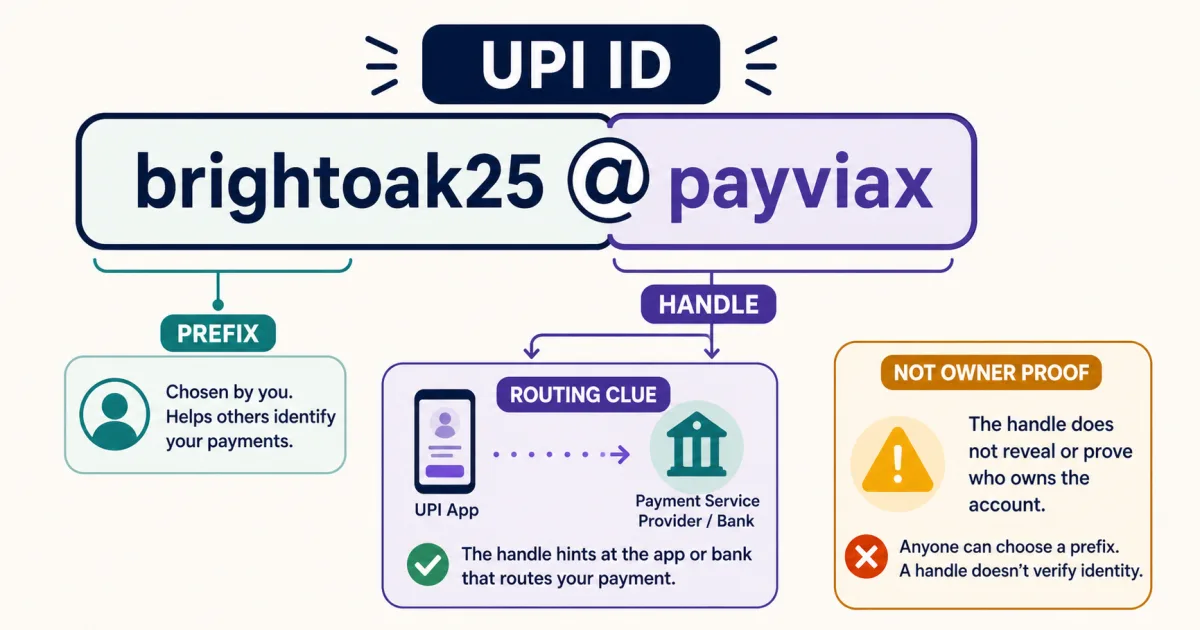
A UPI ID is normally written as prefix@handle. The prefix identifies the specific payment address
chosen or assigned for the user. The handle after @ indicates the bank, app or payment-service-provider
routing pattern that issued the address. For example, @okaxis is associated with Google Pay through
Axis Bank, while @ybl is associated with PhonePe through Yes Bank.
The handle is only a routing clue. It does not prove the owner's identity, confirm that the full UPI ID exists, or guarantee that a payment request is safe.
Anatomy of a UPI ID
NPCI's current BHIM UPI guidance describes the UPI ID as a virtual identity in the form
user@upihandle. The suffix is predefined by the app; the app may allow the user to create or choose a
prefix. In anita@okaxis:
anitais the prefix for that payment address.@separates the address from its handle.okaxisis the handle or suffix used for routing through a Google Pay PSP-bank arrangement.
A person can have multiple UPI IDs for one linked bank account, and changing apps can result in a new VPA with another PSP handle.
Common UPI suffixes and what they indicate
| Handle | Common association | Routing clue |
|---|---|---|
@okaxis | Google Pay | Axis Bank as PSP bank |
@okhdfcbank | Google Pay | HDFC Bank as PSP bank |
@okicici | Google Pay | ICICI Bank as PSP bank |
@oksbi | Google Pay | State Bank of India as PSP bank |
@ybl | PhonePe | Yes Bank as PSP bank |
@ibl | PhonePe | ICICI Bank as PSP bank |
@axl | PhonePe | Axis Bank as PSP bank |
@upi | BHIM / generic UPI pattern | Not one specific account-holding bank |
This is a small reference set, not a complete live NPCI registry. Handles can be introduced, retired or changed, and the relationship between an app and its PSP banks can evolve. Use the UPI Handle Directory for the broader locally bundled list and note its last-reviewed date.
Why the suffix may not match the user's bank
UPI separates the customer's account-holding bank from the PSP bank that connects an app to the UPI network.
PhonePe describes itself as a third-party app participating through Yes Bank, Axis Bank and ICICI Bank. Google Pay
similarly explains that a person with an SBI account can have an ID ending in @okhdfcbank,
@okaxis, @okicici or @oksbi because those handles support routing.
Therefore, “Which bank is this suffix?” normally means “Which PSP bank or app pattern issued this handle?” It does not reliably answer “Where does this person keep their bank account?”
What a handle can and cannot verify
A handle can help you
- recognize a common app or PSP-bank naming pattern;
- spot an obvious misspelling or transposed character;
- understand why an app may offer several UPI IDs;
- choose the correct suffix when copying your own address.
A handle cannot prove
- that the complete UPI ID exists or is active;
- who owns or controls the payment address;
- that the payee name typed into a link or QR is genuine;
- that a payment request, seller or investment is trustworthy.
How to check an unfamiliar UPI handle
- Copy only the part after
@and compare it letter-by-letter with a known handle. - Use the UPI Handle Directory to search by suffix, app or bank.
- Treat a close misspelling as a reason to stop and reconfirm the complete UPI ID with the recipient.
- Enter the full ID in a trusted UPI app and read the recipient name the app resolves before authorizing.
- For a QR or payment link sent by someone else, use the UPI Safety Checker for additional warning signals.
Even a perfectly spelled handle can be attached to a stranger's valid account. The resolved recipient name and the context of the request matter more than a suffix match alone.
What the special @valid handle means
@valid is not a general consumer-app handle. SEBI introduced validated UPI handles for registered
investor-facing intermediaries that collect investor payments. SEBI says these IDs use the exclusive
@valid structure and can be checked through SEBI Check.
If someone claims to be a SEBI-registered intermediary, do not rely on the text @valid alone. Use the
official SEBI Check facility and confirm the verified indication and entity details before sending money.
Related UPI guides and tools
Sources and methodology
- NPCI: BHIM UPI Guidelines 2026 — UPI ID prefix and suffix structure.
- NPCI: About UPI — UPI participants, PSPs, virtual addresses and interoperability.
- Google Pay: smart routing with extra UPI IDs — Google Pay PSP handles and why they can differ from the linked account's bank.
- PhonePe: UPI terms — PhonePe's participation through Yes Bank, Axis Bank and ICICI Bank as PSP banks.
- PhonePe: UPI multi-bank announcement —
@ibland@yblassociations. - SEBI: Validated UPI Handles and SEBI Check — current investor-payment verification framework.
The common-handle table was cross-checked against current first-party app documentation where available and the locally bundled Toolsda directory. The directory is a dated reference list rather than a live NPCI lookup; uncertain or incomplete matches must not be presented as account verification.
Frequently Asked Questions
What is the difference between a UPI ID and a UPI handle?
A UPI ID or VPA is the complete payment address, such as name@okaxis. The handle or suffix is only the part after @. It identifies a payment-service routing pattern, while the complete UPI ID points to a linked payment address.
Which bank is @okaxis?
@okaxis is a Google Pay UPI handle routed through Axis Bank as the PSP bank. That does not mean the user's underlying bank account is necessarily with Axis Bank; Google Pay can link an account from another supported bank through that PSP handle.
Which bank is @ybl?
@ybl is a PhonePe handle associated with Yes Bank as a PSP bank. PhonePe also works through other PSP banks, including ICICI Bank and Axis Bank, so a PhonePe user may have another supported handle.
Does a recognized UPI handle mean the account is genuine?
No. A match only shows that the suffix follows a known bank or payment-app pattern. It does not prove that the complete UPI ID exists, that the typed prefix belongs to the claimed person, or that the payment request is legitimate.
Why can my SBI account have an @okhdfcbank UPI ID?
The handle can name the payment service provider bank that connects an app to UPI, not the bank where the user keeps the linked account. Google Pay documents that an SBI-linked account can use @oksbi, @okhdfcbank, @okaxis or @okicici routing IDs.
What does @valid mean in a UPI ID?
@valid is a special structure introduced for UPI IDs used by SEBI-registered investor-facing intermediaries collecting investor payments. Investors should also use SEBI Check and confirm the verified indication; @valid is not a general bank or personal UPI handle.