The short answer
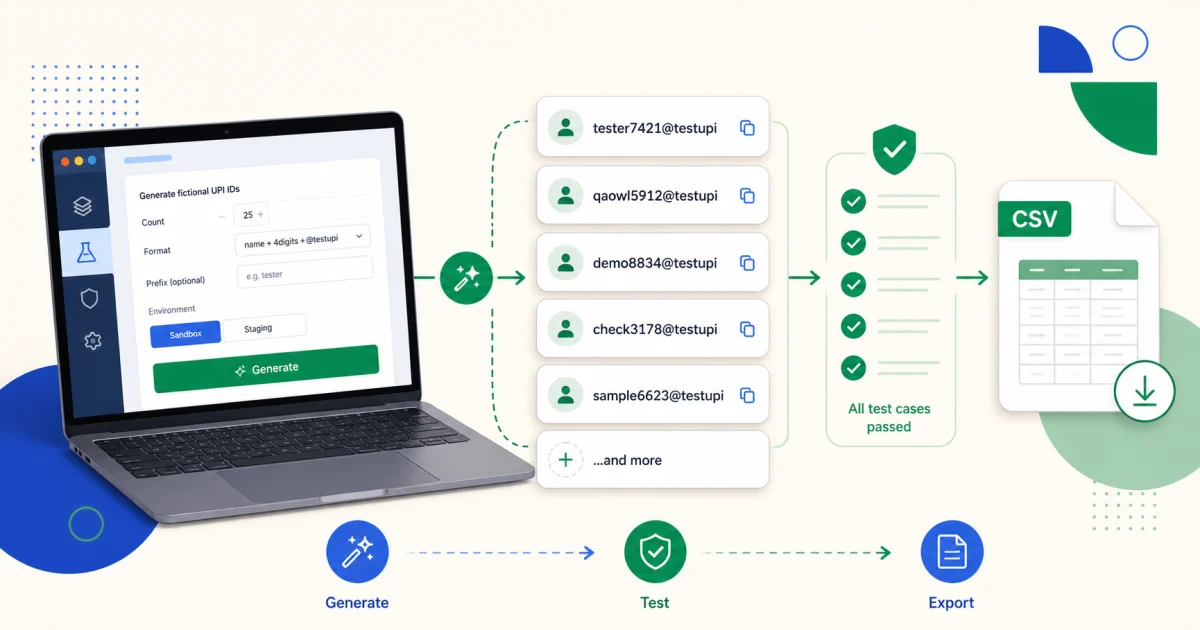
Open the UPI ID Generator, choose a known handle, select a fictional prefix style and generate the number of samples you need. Copy individual values, bulk-copy the set or export a CSV. The output is suitable for UI mockups, test fixtures and form-validation QA—not for making payments.
How to generate test UPI IDs—5 steps
- Choose the test goal. Decide whether you are testing a happy path, an error message, normalization, duplicate handling or bulk import.
- Select a handle pattern. Use a known bank or PSP handle for realistic positive fixtures and an unknown handle for the relevant negative case.
- Pick a synthetic prefix. Prefer obvious markers such as
test,demoorqacombined with random characters. - Generate only what you need. Small, named fixtures are easier to review than a large unexplained dump.
- Keep data out of live payment flows. Store it with test fixtures and make sure staging cannot initiate production UPI intents.
UPI test cases worth covering
| Case | Example shape | Expected result |
|---|---|---|
| Plausible format | test123@knownhandle | Passes local syntax and known-handle checks only. |
| Missing separator | test123knownhandle | Show a clear format error. |
| Empty prefix | @knownhandle | Reject before submission. |
| Unknown handle | test123@unknown | Distinguish unknown from malformed. |
| Whitespace and case | Padded or mixed-case input | Apply your documented normalization policy. |
Format-valid is not payment-valid
A generator does not query NPCI or a bank. It cannot tell whether a VPA exists, whether it is active or who owns it. Even a familiar handle is only a routing clue. Use the UPI ID Checker to inspect syntax and known patterns, but perform any real beneficiary confirmation inside an authorized payment environment designed for that purpose.
Related UPI tools and guides
Sources and methodology
- NPCI: UPI FAQs — VPA registration and UPI fundamentals.
- NPCI: About UPI — the UPI ecosystem and virtual payment addresses.
The tool generates local string fixtures against its bundled handle directory. It never claims live-account verification.
Frequently Asked Questions
Can a fake UPI ID accidentally belong to a real person?
A generated address is only fictional by intent; a format-valid combination could theoretically exist. Never send money to generated IDs, never use them in production payments, and keep test environments isolated from live payment flows.
What makes a UPI ID format-valid?
A basic format check looks for one @ separator, an allowed prefix and a plausible handle and length. Rules vary across PSPs, so passing a local validator is not proof that NPCI or a bank has issued the address.
Should tests use a real bank or PSP handle?
Using known handle shapes can exercise realistic validation paths, but the prefix should be unmistakably synthetic and the fixture should be labeled test-only. Also include unknown and malformed handles for negative tests.
Does the generator create a working UPI account?
No. It creates strings for testing. It does not contact NPCI, open an account, reserve a VPA or verify that any address exists.
Can I export several sample UPI IDs?
Yes. The Toolsda generator can create multiple fictional IDs and download them as CSV. Generation and export happen in your browser.